The Kiwi Crate
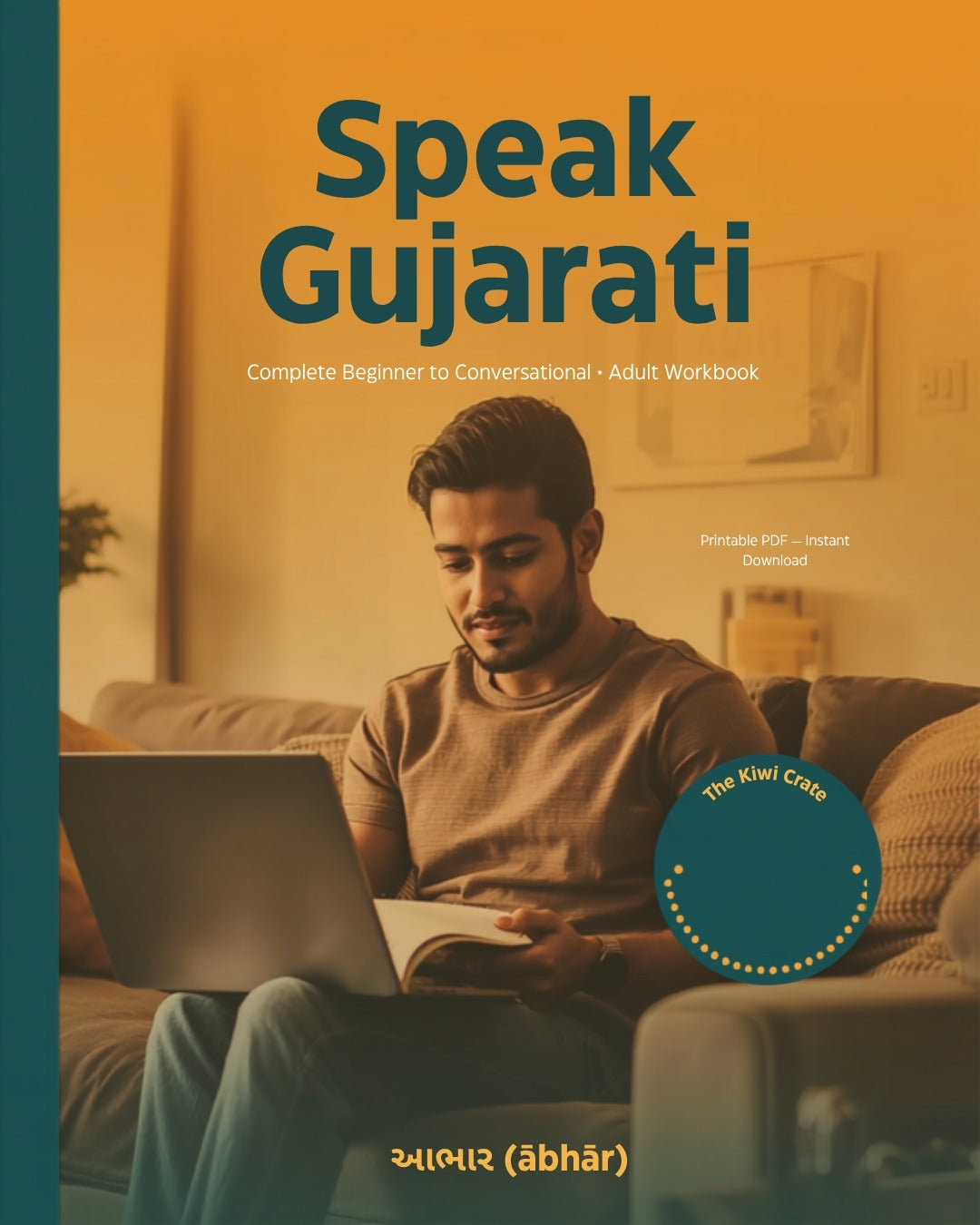
Speak Gujarati — Complete Beginner to Conversational | Adult Workbook
Speak Gujarati — Complete Beginner to Conversational | Adult Workbook
Couldn't load pickup availability
For adults who understand more Gujarati than they can speak
There is a particular kind of frustration that most second and third generation Gujaratis know well. You follow the conversation at a family gathering perfectly. You know exactly what your aunt just said about the food. And when it is your turn to answer, the sentence will not assemble, so you say it in English and watch the moment pass.
That is not a memory problem. It is a production problem, and it is fixable — but not by starting where a tourist phrasebook starts. This course is built for the person who already has the ear and is missing the structure: the script, the sounds, the sentence patterns, and enough repetition to make them arrive without being summoned.
What the course covers
- The Gujarati script — consonants, vowels, and the matras that change them
- Pronunciation — the retroflex and aspirated sounds English does not have, which is where most self-taught learners quietly go wrong
- Greetings, introductions and family vocabulary — the relationship words Gujarati is unusually precise about
- Numbers, dates, time and money
- Food, shopping and everyday transactions
- Directions, travel and getting around
- Emotions, opinions and social conversation — moving past transactions into actual talk
- Phrases for visiting Gujarat
- An audio companion for pronunciation, and an answer key for every exercise
Why the script comes first
Plenty of adults ask to skip the alphabet and learn in roman letters. It feels faster for about three weeks, and then it stops working. Roman transliteration cannot reliably distinguish the sounds Gujarati actually contrasts, so learners who stay in roman script end up with an accent they cannot hear and a ceiling they cannot explain. Learning અ આ ઇ ઈ properly takes a few evenings and it removes that ceiling permanently — and it means you can read a wedding invitation, a shop sign in Ahmedabad, or a message from a cousin.
What makes this different from an app
Language apps are very good at one thing: getting you to show up daily. They are poor at the thing adult heritage learners actually need, which is producing full sentences under mild social pressure. A streak of tapping the right tile does not rehearse saying કેમ છો? to your mother-in-law.
This is a workbook, so it makes you write, and the writing is what transfers. The realistic answer is that most adults do best with both — an app in the supermarket queue, this course two evenings a week. We wrote the honest comparison here: Gujarati apps vs workbooks.
How much time it takes
Two sessions a week of about forty minutes will move you through the material at a comfortable pace. More than that is fine; less than once a week is where people stall, because the sounds fade faster than the vocabulary. If you have children learning at the same time, the Family Learning Bundle pairs this with the children's workbook and the flashcards, which is the version most households actually stick with — parents learning alongside their kids rather than supervising them.
Who it's for
Second and third generation Gujarati adults reconnecting with the family language. Partners marrying into a Gujarati family who would like to follow the conversation at the dining table rather than smiling through it. Anyone travelling to Gujarat, or working with Gujarati-speaking communities in New Zealand, Australia, the UK, the United States, Canada or East Africa.
Common questions
I can already understand Gujarati — is this too basic?
It starts at the script, which most passive speakers have never learned, and moves quickly through vocabulary you will already recognise. Passive understanding usually means you move through the first modules fast and spend your time on production, which is exactly where you need it.
Can I learn without ever reading the script?
You can, and the transliteration is there throughout. We would gently encourage you not to — see the section above on why.
Is the audio by a native speaker?
Yes — the audio companion is there specifically so you can hear the sounds that transliteration cannot represent, and repeat them.
Which dialect is it?
Standard Gujarati, as spoken in and around Ahmedabad and understood everywhere. Kathiawadi and Surti speakers will notice some differences in everyday idiom; nothing that impedes being understood.
How is it delivered?
Digital download after checkout — printable PDF workbook plus audio files. Print it, or work from a tablet with a notebook beside you.
Will this get me conversational?
Honestly: this gets you the structure and the vocabulary for everyday conversation. What converts that into fluency is using it with a person. Ring a relative once a week and insist on ten minutes in Gujarati, however badly it goes at first. Learners who do that get there; learners who wait until they are ready do not.
Share